
Seek and Geek #2
Hertz Contact Stress
Why are bullets tapered at the front? Why is so much of the man made world flat? Why are wheels cylindrical? How much load can a railway car carry? How much can you preload rolling element bearings?
All these questions and more fall are studied in a field known as contact mechanics. Most of the analysis we do is focused on bulk geometry - Thinking about external point forces, the reaction forces and internal stresses. Contact mechanics asks us to focus in on the details. The points at which two components meet.
Hertzian Analysis provides closed form solutions for determining the stress, deflection and stiffness at these interfaces.
For point contact (sphere in larger cavity, sphere on flat, sphere on sphere). These solutions are quite accurate. For other cases less so. “Recent” research has shown the analysis to overestimate the stress by 30%. Some critics have said that even in the ideal case, sphere on flat, it is incorrect. Like all theories, there are both short comings and benefits. The question really is, whether or not adding the additional complexity is worth the additional benefits? Perhaps it is better to do a rough first order calculation than do physical testing. Hertzian contact analysis is still a key tool in the design engineers tool box.
The theory itself is based assumption that the local behaviour is determined by the curvature of the two mating surfaces and their material properties.
Note the relationships and scaling factors.
Object of Interest:
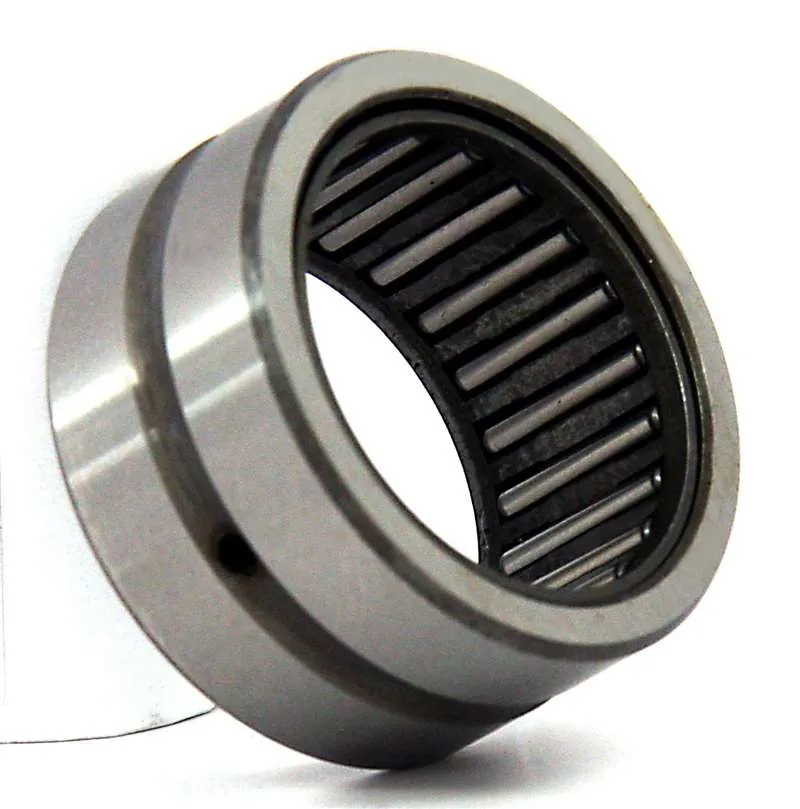
Needle bearing. An absolute breakthrough technology that allowed shafts to be heavily loaded without overloading the bearings. Typical spherical bearings are limited in the amount of load they can take due to the small hertzian contact area. A cylinder on a flat/large cavity however, has an approximately line contact. This is an order of magnitude greater contact area.
What are the relevant physics that engineers needed to consider?
The fact that line contacts have a greater contact areas is beneficial in the fact they reduce local stress. Roughly stress goes like: sigma = F/A
It also, however, means that contact also constrains the body to a greater extent. This means that aligning multiple cylinders perfectly could be a challenge. Small misalignments may lead to edge loading, ouch (think to the equation above). In practice, I would assume that the needle is actual more of a barrel shape with an incredibly large radius.
Why are bearings made from the material that they are? Does steel (elastic, high yield stress) meet the functional requirements for the lowest cost?
The designer should consider the elastic modulus, poisson’s ratio, yield stress, shear resistance (shear loading is high), when deciding which material to use.
What questions or thoughts does it inspire in you?
Is it possible to make bearings that will last forever? or is where inevitable. Must be an incredible mechanical system in a car to compensate for all the dynamical loading. 100’s of kms driven, incredible bearing systems that allow the car to keep on rolling. Image the forces in an air turbine. How large are those bearings? How is an air turbine supported. The dyson one looked like a cantilevered beam, 5 relevant dimensions supported.
Theory is one of the most powerful tools we have. Allows us to collapse the timeline and focus on what matters (the fat low hanging rabbits).