
Seek and Geek #1
Why is it that large trucks have 3 wheels on the back and some have 1? What can it tell us about exact constraint vs elasticity averaged design.
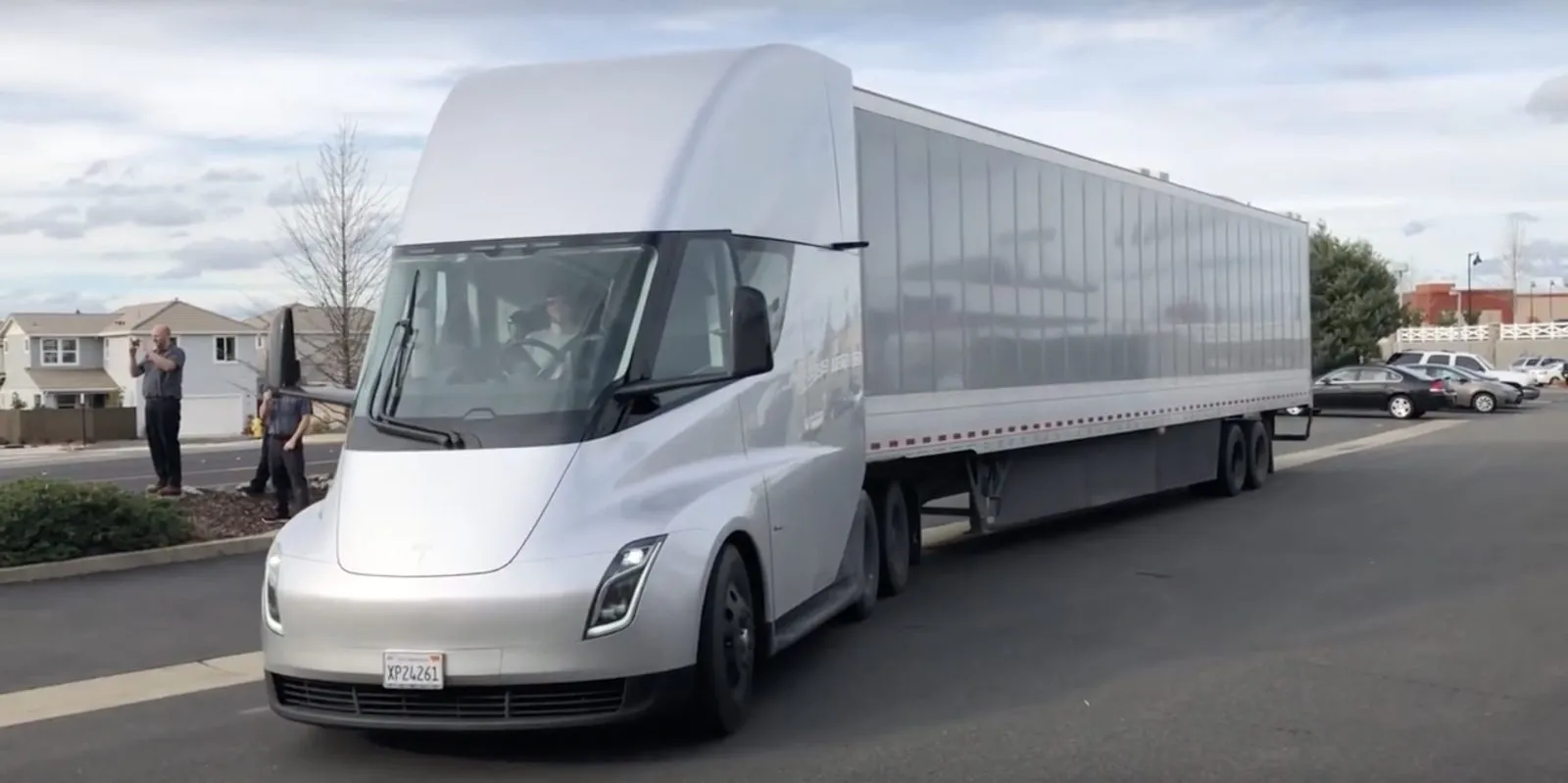
1 - 2 - 2 Wheel Configuration
What is its function?
The purpose of the semi truck is to transport very large amounts of goods, both in volume and weight, long distances. A simple job, but leads to clear implications for the design.
-
High efficiency is desirable - potentially why tesla has given large configurations to the aerodynamics, and you often see these strangely shaped trucks. Make a trade off between manufacturability, simplicity and efficiency.
-
Large battery/fuel tank is desirable - symbiotic relationship with large container on the back, lots of room in the undercarriage for additional fuel.
-
Must be designed to withstand heavy loads - wheel configuration comes in here
What are the relevant physics that engineers needed to consider?
Wheels on a flat surface, Hertzian Contact Analysis can tell us about surface contact pressure. Consider the case of a cylinder on a flat surface.
Other questions. Within what tolerance do the wheels need to be aligned? Can you put them all on a single piece of metal?
Stiffness matters. The back can be considered a simply supported beam. What cross section is required?
Large volume container, buckling is a concern.
Follow the structural loop. Wheels go to shafts, how far are the wheels cantilevered, what is thickness of the shafts. Rigidly connected connected to container? Maybe not best idea. Is it reasonable to make a linear spring which the desired characteristics? Maybe another machine element exists (leaf springs)
What is the frequency of the entire structure. how does this affect the comfort of the driver. How important is the comfort of the driver?
What questions or thoughts does it inspire in you
Have trucks always followed this layout? What did they look like before? Did accidents happen or what caused the design to converge. Even now, why are there differences in design. Some have 1 - 2 - 3 configurations, some have 1 - 3 - 2 configurations. What are the trade offs. Who first thought of designing the semi truck in such a way. Imagine all the other ways in which it could have been designed. What other considerations are there but the stresses. Steering? Was it a designer who could relate to all the considerations (at least all the important ones) that designed the modern day semi? Was it a single designer or a team. What will semi’s look like in the future? Is there any demand for something different? How have standards affected the design, to change the container would require changing the shipping containers as well. Maybe there is a different way.